
 By
By 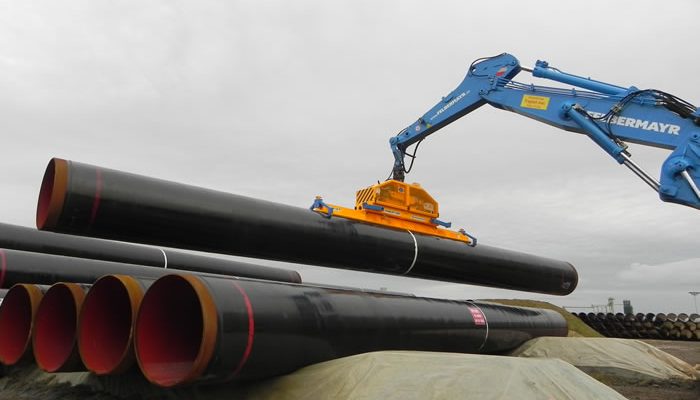
Ask anyone who’s worked on a pipeline project what eats up time on site, and pipe handling will come up quickly. Getting heavy pipe off the ground, manoeuvring it into position, and lowering it accurately into a trench sounds straightforward on paper. In practice, it’s slow, physically demanding, and carries real risk for anyone standing near a suspended load. That’s the problem a vacuum pipe lifter was built to solve, and once you understand how it works, it’s hard to argue with the logic.
The vacuum pipe lifter, known in the industry as a VacLift, is a hydraulic vacuum attachment that mounts directly onto an excavator or other earthmoving machine. Instead of rigging chains or slings around a pipe and lifting from underneath, the VacLift clamps onto the pipe’s surface using suction. A rubber seal holds firm against the pipe wall, and the operator controls every movement from the cab. No labourers on the ground steadying the load. No rigging to set up. Just attach, lift, and position.
How a Vacuum Pipe Lifter Works
The mechanics of a vacuum pipe lifter are less complicated than they sound. It has two main components: a “shoe” that creates the suction contact point, and a rubber seal that sits between the shoe and the pipe surface. When the vacuum is engaged, the shoe grips the pipe securely. The seal does two jobs at once: it maintains the grip and protects the pipe’s outer coating from being scratched or dented during handling, which matters on coated gas and water mains where surface damage can compromise corrosion protection.
Speed That Actually Shows Up on the Schedule
Traditional slinging methods, where workers rig chains or straps around the pipe before each lift, take an average of around four minutes per pipe. With a VacLift, the same lift takes less than a minute. That might not sound dramatic until you do the maths across a full day’s lay. On a busy pipeline section, that difference compounds into hours of recovered productivity every single shift.
It’s also worth understanding what “three times the output” actually means in real terms on a working site. It doesn’t just mean pipes get placed faster; it means the excavator spends more time doing productive work and considerably less time idle while crew on the ground rig and de-rig. The machine, the operator, and the rest of the crew stay in rhythm instead of waiting on each other.
What Sizes and Pipe Types It Handles
One of the more practical points about vacuum lift technology is its range. The VacLift is available in multiple sizes, designed to match different excavator classes and pipe diameters. In terms of weight capacity, it handles poly piping weighing up to a few hundred kilograms at the lighter end, and steel pipe weighing up to 20 tonnes at the heavy end. That covers the vast majority of what gets laid on gas, water, and civil pipeline projects across Australia.
Extension arms can also be added to increase reach and give the operator more flexibility in tight corridors or awkward trench approaches—a common challenge on urban pipeline work where access is constrained and there is little margin for repositioning the machine.
Why the Safety Argument Is Compelling
Ground-level pipe handling has always been one of the higher-risk activities on a pipeline site. Suspended loads, manual steadying, and working close to moving machinery—each of those factors introduces a hazard. The VacLift entirely removes the need for workers to be on the ground near the lift. The operator handles everything from the cab, with full control over the pipe’s movement throughout the lift and placement.
Designed and Built in Australia
The VacLift was developed, patented, and manufactured in Australia, specifically for the conditions and demands of Australian pipeline construction. That origin matters because the design was shaped by the people who actually use it, on the types of projects it’s now deployed across. It’s not an adapted product from another industry; it was built for this one from the ground up.
Final Thoughts
Vacuum pipe lifting technology has changed what’s operationally possible on pipeline construction sites. Faster cycle times, less physical risk, better pipe handling precision, and no coating damage. Those are not merely incremental improvements; they add up to a meaningfully different way of working. For any project where pipe handling volume is high and schedule pressure is real, it’s worth understanding exactly what this technology brings to the table.


















Comments